
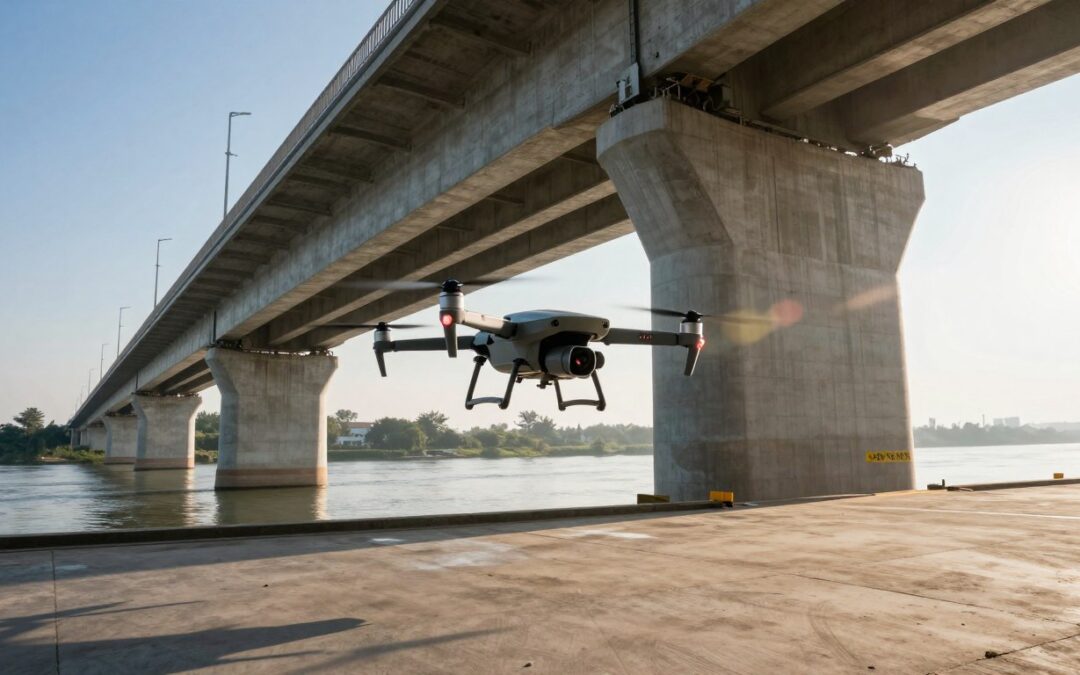
Can drones change how we check and watch over bridges? The use of Unmanned Aerial Vehicles (UAVs) in bridge inspection is becoming more popular. It brings many benefits, like better safety, faster inspections, and less traffic control.
The National Academies of Sciences, Engineering, and Medicine say UAVs are being used more for bridge inspection and monitoring. They point out the advantages of saving time and improving safety.
As transportation departments look into UAVs, solving the problems of drone launching and retrieval under bridge platforms is key. Learning from innovative uses of under-bridge access platforms can help.
Key Takeaways
- UAVs improve safety and reduce inspection time in bridge monitoring.
- Effective drone launching and retrieval strategies are critical.
- Innovative under-bridge access platforms offer valuable lessons.
- Combined surveys benefit from UAV technology and under-bridge access.
- Addressing challenges is essential for UAV adoption.
Essential Equipment for Under Bridge Drone Operations
Under bridge drone operations need special gear for safety and efficiency. The right tools improve data quality and lower risks in tight spaces.
Specialized Drones for Bridge Inspection
Specialized drones for bridge inspection are key. They have high-res cameras and sensors for detailed images and data under the bridge.
Collision-Tolerant Models
Collision-tolerant drone models are great for under bridges. They can handle bumps without getting damaged, saving time and effort. For example, the Oklahoma DOT uses UAVs for bridge checks, adding to traditional methods with wide-angle photos.
Safety Equipment and Backup Systems
Along with special drones, safety equipment and backup systems are essential. This includes tools for emergencies, extra batteries, and backup systems for non-stop work.
Emergency Recovery Tools
Emergency recovery tools are critical for drone issues or lost signals. They help safely get drones back, avoiding damage or loss. For more on bridge tech, check Under Bridge Platforms.
- Backup batteries for ongoing work
- Redundant systems for drone parts
- Emergency tools for safe drone retrieval
With the right gear and training, under bridge drone work gets safer and more efficient. For more on drone bridge inspection, see Acecore Technologies.
Drone Launching Under Bridge Platforms: Techniques and Safety
Launching drones under bridges needs the right techniques and safety steps. These are key for a successful operation. The launch platform must be stable and secure for the drone.
Platform Selection and Preparation
Choosing the right launch platform is the first step. A report by The National Academies of Sciences, Engineering, and Medicine talks about the challenges. For more on picking the right platform, visit Understanding Load Capacities and Reach.
When getting ready the launch platform, think about these things:
- Stability and Leveling: Make sure the platform is stable and level to avoid accidents or damage to the drone.
- Safety Features: Add safety features like guardrails and emergency shutdown systems.
- Environmental Conditions: Check the environment, including wind speed and direction, for the best launch plan.
Launch Procedures in Confined Spaces
Launching drones under bridges is tricky. The space is small, making it hard to see and navigate. To tackle these issues, it’s important to:
- Do thorough pre-flight checks to make sure the drone works well.
- Use a drone with obstacle avoidance to lower the risk of crashes.
- Watch the drone’s performance live to adjust as needed.
Managing Environmental Challenges
It’s vital to manage environmental challenges for safe drone use. Things like wind, temperature, and humidity can affect the drone. For a detailed guide on drone bridge inspection, see Drone Bridge Inspection Guide.
Here are some ways to handle environmental challenges:
- Wind Mitigation: Choose drones that can handle wind or launch when winds are low.
- Temperature Control: Keep the drone’s battery and electronics safe from extreme temperatures.
- Humidity Management: Use drones that can handle wet or humid conditions.
Effective Drone Retrieval Methods for Bridge Surveys
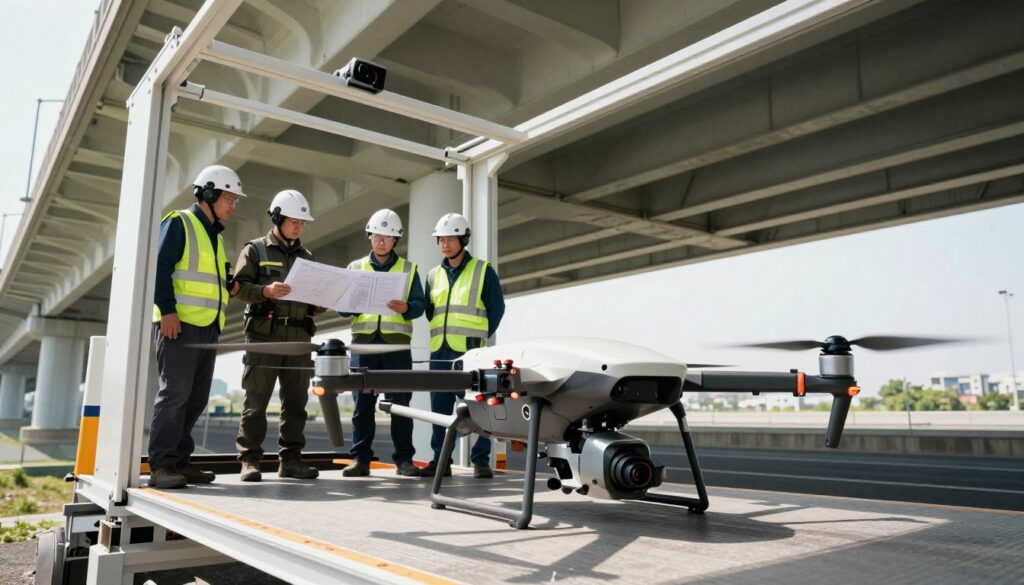
Drone retrieval is key in bridge surveys, needing precision and safety. Looking into under bridge drone operations shows how important retrieval methods are. They play a big role in the success of these surveys.
Recovery Techniques in Limited Space
Getting drones back from under bridges is tricky due to tight spaces. Effective recovery techniques are vital to avoid drone damage and keep people safe. Using under bridge platforms helps make retrieval safer and more controlled.
Using a tethered drone system makes retrieval easier, even in tough spots. It allows for a stable and controlled process, lowering accident risks.
Data Management During Retrieval
Handling data from drone surveys is critical, even when getting the drone back. It’s important to store and back up data well to avoid loss. Strong data management systems are needed to handle drone data.
For instance, mixing visual and thermal data gives a full view of bridge conditions. A study found that combining data types makes surveys more accurate. This helps in making better maintenance choices.
This integration is key for a detailed assessment.
Integrating Multiple Survey Types
Using different survey types, like visual and thermal imaging, makes bridge surveys better. Thermal imaging spots small temperature changes that could mean trouble.
Combining Visual and Thermal Data
Putting visual and thermal data together gives a clearer picture of bridge health. This mix can show things that one type alone might miss.
| Data Type | Benefits | Applications |
|---|---|---|
| Visual | High-resolution imagery, detailed inspection | Surface damage detection, structural analysis |
| Thermal | Temperature variation detection, non-invasive | Identifying structural issues, heat leakage |
| Combined | Comprehensive assessment, enhanced accuracy | Maintenance planning, repair prioritization |
For more on drones in construction inspections, including bridge surveys, check out FlyByGuys.
Conclusion
UAVs are changing how we inspect bridges, thanks to drone launch technology. The Oklahoma DOT’s journey shows both the benefits and hurdles of using this tech. They faced costs, tech limits, and training needs.
Drone technology is set to become key in making bridge checks safer, faster, and more accurate. Knowing what drones need and how to use them safely is key. This way, we can fully use drone tech’s advantages.
While using drones for bridge checks has its challenges, the benefits are worth it. We need to tackle the main obstacles like cost, tech, and training. This will help drones become a standard in bridge inspections.
Recent Comments